
Positive Behaviour 4 Learning (PB4L)
Positive Behaviour 4 Learning (PB4L) at SFX
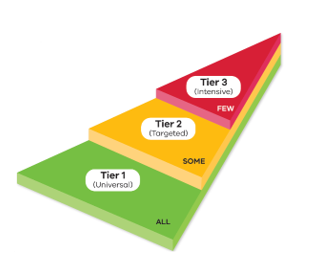
Positive Behaviour for Learning (PB4L) is a framework that uses a three-tiered continuum of support to improve student wellbeing and behaviour. The tiers represent levels of intervention, not categories of students.
- Tier 1: Universal Support (All Students)
- Focus: Prevention and school-wide systems.
- Description: This is the foundation for all students across all school settings. It involves explicitly teaching expected behaviours (e.g., being respectful, responsible, and safe) and providing positive reinforcement.
- Reach: Effectively supports approximately 80–85% of students.
- Tier 2: Targeted Support (Some Students)
- Focus: Early intervention for "at-risk" students.
- Description: Designed for students who do not respond to Tier 1 universal supports. Interventions are typically high-efficiency, rapid-response, and may be delivered in small groups, such as social skills instruction, mentoring, or self-regulation strategies.
- Reach: Typically supports about 10–15% of the student population.
- Tier 3: Intensive/Personalised Support (Individual Students)
- Focus: Highly individualised, intensive intervention.
- Description: For students with high-risk behaviours or complex needs who require a more personalised approach. This level often involves comprehensive behavioural assessments and "wrap-around" support including family, community services, and mental health professional
- Reach: Usually applies to 1–5% of students who need the highest level of support.
Rights:
As members of the College community, students have a right to:
- Enjoy a safe and ordered environment
- Be unhindered in their attempts to attain their educational goals
Responsibilities:
As students they have responsibility to:
- Be respectful and be courteous to others
- Be appreciative and be tolerant of differences
- Use their talents, gifts, and abilities to the full
- Always strive to do their best
- Know and follow all College rules and expectations
- Make their own informed decisions and accept responsibility for their actions
SFX Merit Procedure
Positive feedback – Acknowledging Expected Behaviour
Acknowledgments are teacher actions to provide positive feedback to students. They can be verbal (e.g. specific descriptive praise) and non-verbal (e.g. thumbs up). They can also include a merits.
Merits are awarded in line with College values and for effort and application in class.
Free and frequent, regular positive praise is encouraged that is behaviour specific.
Follow up from behavioural errors
Staff, students and parents aim to work together to have appropriate outcomes for a behavioural error.
Where possible, follow up of errors is designed to be aligned with the type of behaviour.
Students are expected to be accountable for their actions. This may include additional work being set, limitations to time on the yard or in the classroom, reporting to teachers and meetings with College staff.
- Detentions are issued by staff in leadership positions for more serious behavioural incidents or failure to meet expectations around uniform and/or mobile phone use. Detentions are held during lunch and also after school hours and are supervised by members of staff.
- Suspensions are instigated when other methods of follow up have been ineffective and/or for significant behavioural errors. They are issued under the direction of the Principal and Assistant Principal Wellbeing and Engagement and with parental consultation. When students breech major expectations of the College, they can expect to be faced with a period of suspension. The length of the suspension will vary in accordance with the seriousness of the incident and the history of the student. Parents will be consulted during the suspension process. Students will be required to have a ‘re-entry interview’ before returning to the College.
- Exclusions from College events are used for specific disciplinary matters. They generally relate to any behaviour that is connected to specific activities (such as sporting issues or misbehaviour while on excursions) and may include being prohibited from attending any of the College’s functions (including the Graduation Ceremony).
- Exclusions from the College are aligned to the most serious matters. In such circumstances the College Principal consults with the Catholic Schools staff.
Suspensions and exclusions are serious matters. Students would expect that if they were involved in an incident that warranted such consequences, then their attitudes would be reflected in the Year 12 College Reference.
Unfortunately, on occasions, students can become involved in illegal activities. The College will cooperate fully with any police investigation and refer any illegal actions to the police as part of its procedures. Students can be prohibited from being on the College premises if they are under a police investigation.
Serious Matters Relating to College Discipline:
- Alcohol - The consumption and/or possession of alcohol in any form is strictly prohibited. Students are not to be at the College, or be involved in any College-based activity, while under the influence of alcohol or in possession of alcohol.
- Tobacco/Vaping - The smoking and/or possession of any type of tobacco or vape product is prohibited.
- Unlawful Drugs - Under no circumstances will the use or possession of unlawful drugs of any kind be permitted.
- Violence - The College has a Non Violence Policy which prohibits; fighting, hitting, pushing, wrestling, or any other physical contact. The College enforces this rule for the safety and wellbeing of all its staff and students.
- Endangerment - Any action that directly, or indirectly, endangers a member of staff or another student will be considered as very serious. This includes the carrying of weapons (or items that are to be used as weapons), abetting the presence of unauthorised persons and threats of violence.
- Cyber and Phone Activity - Using the internet and/or phone to bully, harass, send inappropriate images, access inappropriate images, threaten, organise unacceptable activities is not accepted.
- Respect for a person’s property - The property of other people is to be respected. Therefore, behaviour such as stealing or wilful damage is not tolerated.
- Respect for the College - The College reserves it’s right to protect its good name and it does not tolerate any activity that undermines it. Frequently, graduating students rely on the good name of the College in their career endeavours.
- Unauthorised absence from school - Students are not to leave the College without prior approval from their parents/carers and the College.
Students can expect that the actions stated above will lead to significant follow up. Such follow up may include suspension and exclusion. As most of these actions are illegal students can also expect that there may be police involvement. The College has a practice of actively working with the police in incidents that are illegal.