College Themes
FULL OF GRACE Transform the World with God's Love
Image Reflection
In the image of Jesus kneeling to wash the feet of his disciples, we encounter grace in its most tangible form. God’s love in action. This moment, quiet yet revolutionary, reveals the heart of the theme Full of Grace – Transform the World with God’s Love. It is not a display of power or grandeur, but of humility, presence, and service.
The artwork comes from a series of icons titled The Way of the Family by Australian artist and iconographer Sue Orchison. In this image Washing of the Feet, “Jesus is servant; He humbles himself and asks us to do the same.”
Jesus, “full of grace and truth” (John 1:14), chooses not to command but to kneel. He does not seek recognition but offers tender service. In this act, grace becomes visible: undeserved, unmeasured, freely given. It is a love that lowers itself to lift others up, a love that transforms.
This image invites us to reflect on our own “yes” to grace. Like Mary, whose bold and courageous yes allowed God’s love to shape her life, we are called to echo that yes in our own time. In a world aching for peace, where division and fear often speak louder than hope, grace whispers another way. It asks us to kneel, to listen, to serve.
Let this image be our challenge and our inspiration. Let it remind us that grace is not abstract, it is the touch of God in the ordinary. And when we receive it, live it, and become it, we do more than reflect God’s love, we transform the world with it.
Theme Introduction
Diocesan Theme 2026 – Overview
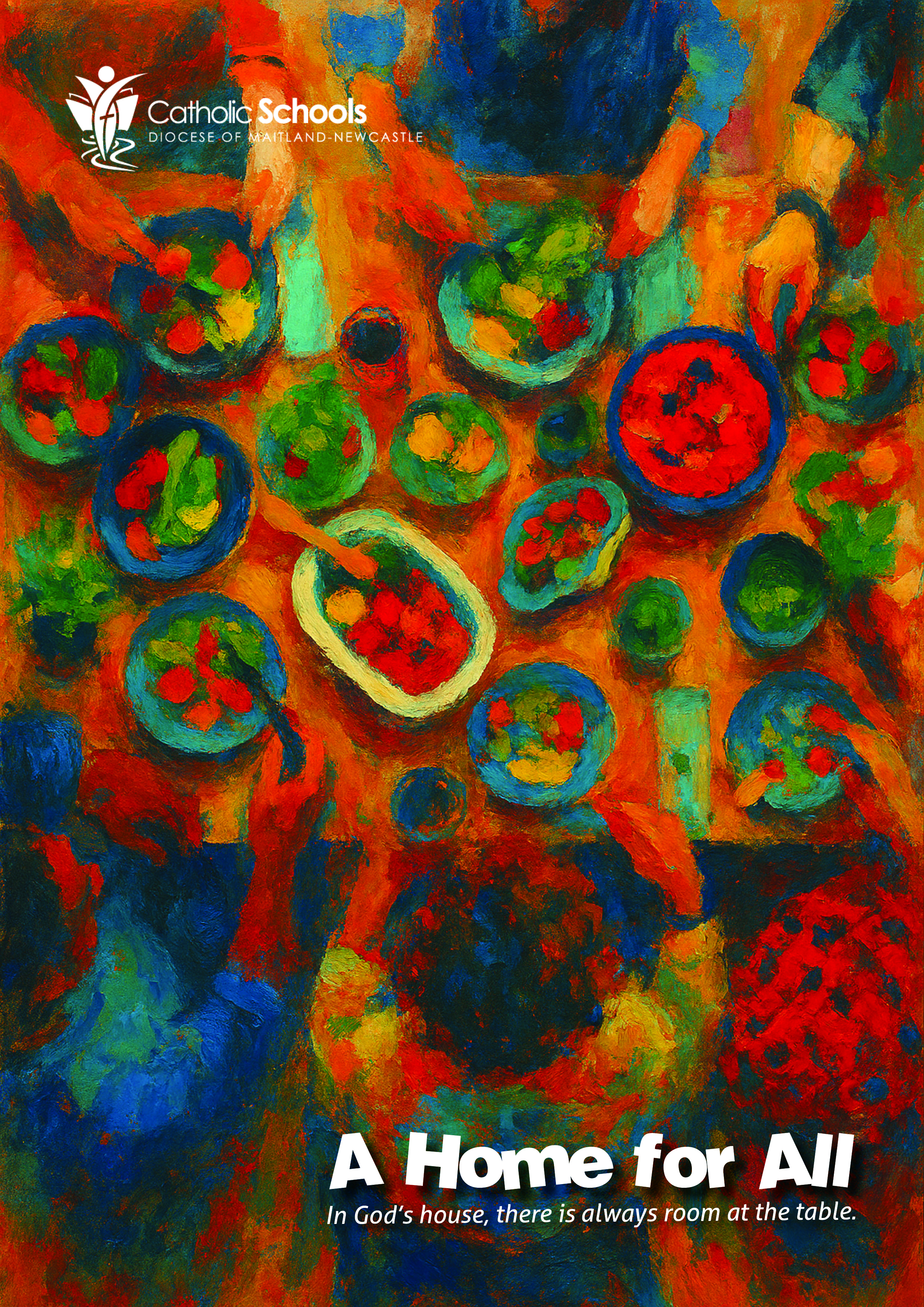
A Home for All
In God’s house, there is always room at the table.
Several years back, the iconic Masterfoods brand launched a campaign that set out to #MakeDinnerTimeMatter. Their campaign was in response to research conducted across Australia that indicated that people make more meaningful connections when they share a meal with loved ones. Part of the campaign included the development of an advertisement where they interviewed parents, asking, “If you could have dinner with anyone living or dead, who would you choose?” Their answers were predictable: world leaders, cultural icons—Nelson Mandela, Bob Hawke, even Justin Bieber. Then the same question was posed to their children, and their responses were strikingly simple: “Probably with my whole family.” That answer carried a quiet power. It reminded us that belonging often begins in the ordinary.
There is something deeply human when we gather around a table with others. The image itself provides a rich symbol of inclusion and welcome; it represents a homely place where stories are shared, laughter takes place, and relationships grow. It is around the table where individuals feel the words, you matter here. In a world marked by division and isolation, this image feels almost countercultural. Yet, in our Catholic schools, we see this hospitality lived out daily—places are created where every individual is seen, known and loved. This is the heart of our 2026 theme:
A Home for All.
The early Christians understood the concept of home well: “All who believed were together and had all things in common… they broke bread at home and ate their food with glad and generous hearts” (Acts 2:44–47). Such actions transformed their homes into places of communion, where all shared life and hope was cultivated. Pope Leo XIV reminds us: “Jesus continues to trust. He continues to sit at the table with his followers. He does not give up breaking bread, even for those who will betray him. This is the silent power of God: He never abandons the table of love.” Such words portray the radical hospitality of Christ – a love that never excludes, a peace that always disarms, and a unity that continually forgives.
To create a home for all means more than just the warm and fuzzy sentiments of polite inclusion. It calls for us to create intentional Catholic communities, where we strive to develop culture permeated by the Gospel, where differences are not erased but embraced, where our mission is more than a visual cue in our foyers, but rather, it is shared and lived. Henri Nouwen once wrote, “We are not the healers, we are not the reconcilers, we are not the givers of life. We are sinful, broken, vulnerable people who need as much care as anyone we care for.” In other words, to make this home possible, humility comes first. When we create homes that allow us to see ourselves clearly, we can’t help but be reminded that each person belongs because first we belong to God.
As we embrace this theme, let us ask ourselves:
- Who are those in our community that feel they have no place at the table?
- How can our daily interactions and practices reveal the face of Christ?
- What bridges can we build to combat the division and fragmentation we witness in our world?
May our theme in 2026 spur our Catholic schools to become living signs of God’s house, where the table is wide, the doors are open, and the Spirit binds us together in peace. For in God’s home, there is always room, and always love.
Ryan Gato
Head of Religious Education and Spirituality